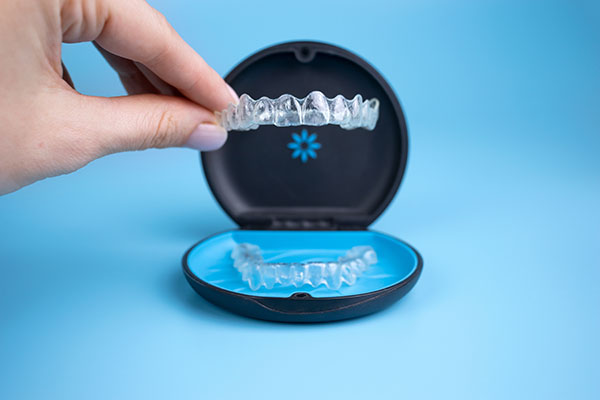
Understanding the pros and cons of Invisalign® and veneers is an important first step to deciding which treatment option is right for you. Many are familiar with Invisalign for a straighter smile, but fewer have heard of veneers for orthodontic treatment. This review offers insights into Invisalign and veneers as it relates to correcting teeth alignment concerns.
A discussion of Invisalign® and veneers
Invisalign and veneers may both be available treatment options in patients who have minor teeth alignment concerns. They both offer unique benefits, although one is often a better option than the other depending on the specifics of the patient’s treatment needs and goals.
Invisalign® explained
Invisalign is one of the most popular and most trusted brands of clear aligners treatment. Treatment involves the patient wearing customized aligners over teeth, which slowly pull and push teeth until the ideal alignment is achieved. They typically are used to fit mild to moderate instances of misaligned teeth, overcrowding, protruding teeth, teeth gaps and jaw misalignments. Many patients prefer Invisalign aligners over other treatment methods due to the transparency of the aligners and the ability to remove them whenever it is necessary to do so.
Dental veneers explained
Dental veneers are layers of porcelain that are custom-crafted and applied to the visible surface of teeth. They differ from Invisalign as they do not actually shift teeth into a different alignment. Instead, dental veneers can fix minor alignment concerns by altering the size and shape of a tooth. They can also fix issues of gaps between teeth as well. However, they are not ideal for more severe misalignments as they do not shift teeth into a different position. Dental veneers treatment is much faster than Invisalign treatment, and the entire process typically only takes around a month.
How the treatment process works
The treatment process for Invisalign and veneers is very different. With Invisalign, the process involves taking a dental impression, creating the custom Invisalign aligners, wearing the aligners 20 to 22 hours a day and receiving new aligners periodically until the patient reaches the ideal alignment. Dental veneers are simpler, and it involves preparing the tooth (which may involve removing a small amount of enamel), customizing the veneers in a laboratory and a non-invasive placement procedure once the veneers arrive back to the dentist.
How to choose the best option
You can decide the best option by discussing both Invisalign and veneers with a dentist. In general, Invisalign is ideal for patients with a mild to moderate misalignment that requires the pulling and pushing of teeth to reach the ideal alignment. For minor orthodontic concerns that do not require straightening the teeth, veneers may be an option. There is no one answer to which option is the best, as the needs and preferences of each patient are unique.
Discuss Invisalign® with an experienced dental professional
If you would like to discuss Invisalign treatment with a dental professional, contact our dental office. We help Invisalign patients through the treatment process, ensuring all of your questions and concerns are addressed along the way.
Request an appointment here: https://www.blissdentalsf.com or call Bliss Dental SF at (415) 200-1283 for an appointment in our San Francisco office.
Check out what others are saying about our dental services on Yelp: Invisalign in San Francisco, CA.
Related Posts
Invisalign® is increasingly becoming a very popular teeth-straightening treatment option. The process is simple and relatively comfortable, which is why it is growing in popularity. However, because it is not as old or traditional as braces, it can be helpful to get familiar with how exactly the process works. Keep reading to learn more about…
A cosmetic dentist specializes in enhancing the appearance of the teeth, gums, and smile through various treatments designed to improve both function and aesthetics. While general dentists provide essential care to maintain oral health, a cosmetic dentist focuses on cosmetic procedures that can transform the look of your smile. Visiting this professional offers several key…
A consultation with a cosmetic dentist is the essential first step in achieving a radiant, confident smile. If you are looking to restore your smile, these personalized treatment plans can address multiple concerns, including discoloration, chips, misalignments, and missing teeth. The following blog outlines what you can expect during this initial appointment and helps you…
Seeking timely gum disease treatment can reverse the early effects of tissue inflammation before permanent damage compromises the foundational structures of the mouth. The initial phase of gum disease, known as gingivitis, develops quietly without causing significant physical pain or obvious distress to the patient. Our general dentist identifies these subtle tissue changes during routine…